Chicago buildings you pass branch by branch
A river cruise follows the water, so the buildings come in the order the river sets. The main branch carries the famous names, the South Branch leads to Willis Tower, and the North Branch is quieter. Not every cruise goes down all three.
Three branches and a meeting point
The Chicago River has three parts, and every architecture cruise is planned around them. The main branch runs west from Lake Michigan to Wolf Point. There the North Branch comes in from the northwest while the South Branch bends away to the south. Most 90-minute tours head up the main branch first, look up each of the other two branches, then turn back toward the lake past the Riverwalk on the south bank. After the Great Chicago Fire of 1871 wiped out much of the center, the city rebuilt along these banks with a confidence that has not let up since, so a cruise works like a timeline of American building.
The main branch, from Michigan Avenue to Wolf Point
The first stretch packs in the most. At the Michigan Avenue bridge, two towers from the 1920s face each other across the road. The Wrigley Building, clad in white glazed terra-cotta, has a clock tower modeled on the Giralda in Seville. Across the street rises the Neo-Gothic Tribune Tower, the winner of a 1922 design competition that drew more than 260 entries. Its base holds about 150 stones and fragments from buildings and sites around the world, which you can see up close if you walk past before boarding.
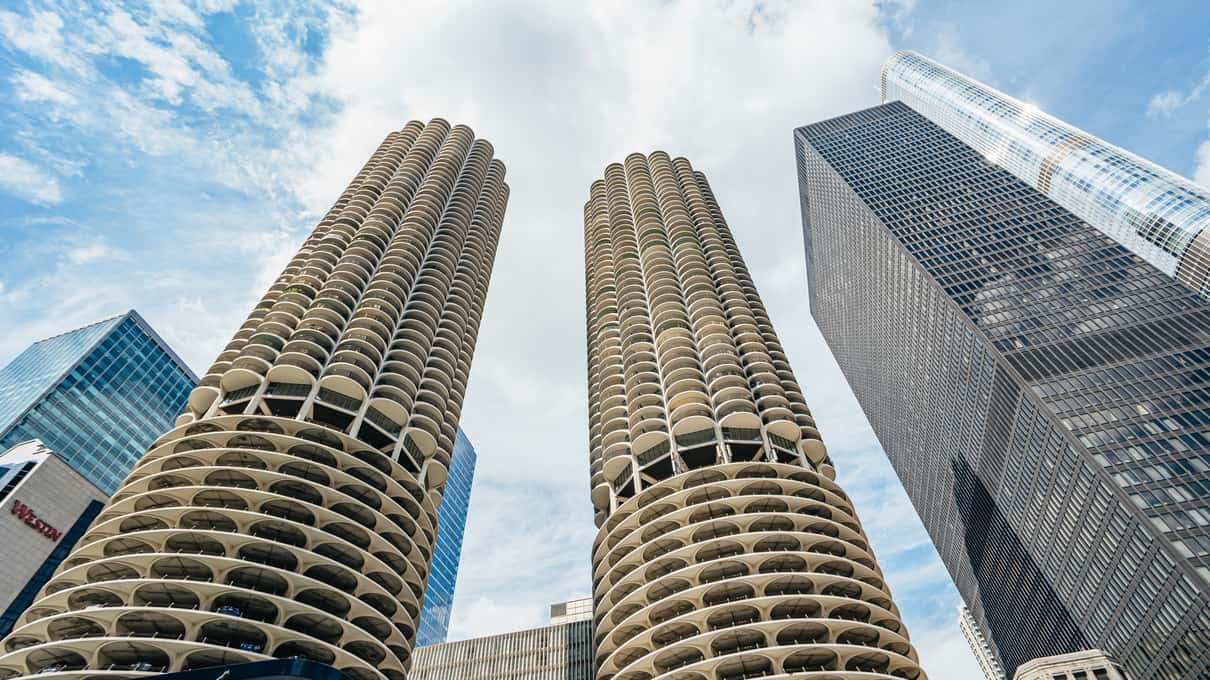
West of the bridge, the glass Trump International Hotel and Tower steps back in stages, each step meant to echo the height of a neighbor. Then come the two round towers of Marina City, Bertrand Goldberg's 65-story "corncobs" from the 1960s. Cars park on open spiral ramps in the lower 19 floors, and a marina sits at water level. Beside them stands the dark AMA Plaza, the former IBM Building, one of the last works of Ludwig Mies van der Rohe. Its plain black grid next to Goldberg's curves makes one of the sharpest contrasts of the trip.
Farther west, the red brick Reid Murdoch Building with its clock tower sits on the north bank between Clark and LaSalle streets, a relic of the days when wholesalers lined the river. Look south down LaSalle Street for the Chicago Board of Trade, an Art Deco tower that closes the view at the far end. Near the bend, 333 Wacker Drive curves its green glass wall to follow the river, and on a calm day the whole bend is mirrored in it. Not far off on the north bank is the Merchandise Mart, which opened in 1930 as the largest building in the world. After dark its river facade becomes a screen for the Art on theMART projections, one reason to look at evening cruises as well.
Down the South Branch to Willis Tower
Turning south at Wolf Point, the boat runs between the walls of the West Loop. Seen from the water, the Civic Opera House of 1929 looks like a giant armchair, a tall central block between two lower wings. That shape earned it the nickname "Insull's Throne" after Samuel Insull, the utilities magnate behind it. Farther down, 311 South Wacker shows off its crown, a ring of glass that glows after dark. The big moment comes at Willis Tower, the former Sears Tower, 1,451 ft (442 m) tall. From river level you see how its bundle of square tubes drops away in stages toward the top, a structural idea from engineer Fazlur Khan at SOM.
Wendella's own site describes its 90-minute route as reaching from Goose Island down to Chinatown, though the captain decides where to turn on the day.
Fifty buildings with a docent
The Architecture Center cruise from ~$57 covers all three branches and over 50 buildings, narrated by volunteer docents trained by the Chicago Architecture Center.
Up the North Branch
The North Branch is the quieter arm. Here the river narrows. Converted loft buildings and newer apartment blocks stand close to the water, and the big towers drop behind you. Wolf Point itself, the spit of land where the branches meet, has filled with glass office and apartment towers in recent decades. Upstream, the old Kinzie Street railroad bridge often stands raised, a steel bascule leaf pointing at the sky. Some tours push on toward Goose Island, an industrial island that the river splits around, before turning back.
East toward the lake
The last stretch before the lake shows the newer skyline. Aqua, by Jeanne Gang's Studio Gang, rises 859 ft (262 m) with balconies that ripple out up to 12 ft (3.7 m) from the facade, so the tower seems to ripple like water. Her later St. Regis Chicago, first known as Vista Tower, is the third-tallest building in the city, a cluster of stepped glass towers in shades of blue-green. On the north bank the NBC Tower of 1989 borrows its setbacks and pale stone from the 1930s, a postmodern nod to Rockefeller Center. Last comes Lake Point Tower, the curving glass apartment block that stands alone east of Lake Shore Drive.
On Wendella's lake cruise, this is where the river leg ends and the lock begins. The lake and river guide covers what you see from the water beyond it.
From the Chicago School to curved glass
You do not need the style labels, but they help the commentary stick. The Home Insurance Building of 1885, by William Le Baron Jenney, is often called the first skyscraper. It stood in the Loop until 1931, and the Chicago School that followed used steel frames to push buildings higher with big windows. Along the river the story moves on through Neo-Gothic at Tribune Tower to Art Deco, which you see in the Merchandise Mart and the Board of Trade. Mies brought the steel-and-glass modernism of AMA Plaza, and Goldberg answered with the concrete curves of Marina City. Postmodern towers such as 333 Wacker Drive and NBC Tower came in the 1980s, while Studio Gang shows where the skyline has gone since. The docents on the Architecture Center cruise go deepest into these styles, which the listing traces from Art Deco to postmodernism.
The bridges overhead
No other city in North America has as many movable bridges. Counts put the number on the river at 37 or 38, and most of the ones you pass under are bascule bridges. Each leaf pivots on a heavy counterweight and tilts up to let tall boats through. Look for the small bridge houses at the corners, which hold the machinery that lifts each span. The Michigan Avenue bridge, which opened in 1920, is the one most cruises board beside, and the Architecture Center cruise counts 13 bascule bridges on its route. For framing the steel undersides in a photo, see our photography tips.
Which cruises cover which branches
| Cruise | From | Length | Branches |
|---|---|---|---|
| Wendella 90-minute tour, our pick | ~$45 | 1.5 h | All three |
| Architecture Center cruise, First Lady | ~$57 | 1.5 h | All three |
| Shoreline architecture cruise | ~$39 | 75 min, shorter in winter | All three |
| Chicago Line tour with drinks | ~$42 | 1.5 h | All three |
| Wendella 45-minute cruise | ~$28 | 45 min | Main branch, then the South Branch to Willis Tower |
| Wendella Lake and River | ~$45 | About 90 min | Main branch to Wolf Point, then the lake |
Four cruises cover the whole river. Wendella's 90-minute tour from ~$45 has the largest review base, while Shoreline from ~$39 is the cheapest way to see all three branches. Chicago Line from ~$42 adds free soft drinks. The 45-minute cruise from ~$28 runs from Lake Shore Drive to Willis Tower along the South Branch, so it misses the North Branch. If you are still choosing, which cruise to pick weighs them by priority, and our dock guide shows where each one boards.